
Speaker: Gökhan Karabıyık, Aksaray University, Türkiye
Date: May 21, 2026, 17:00
Location: MS TEAMS online
Summary
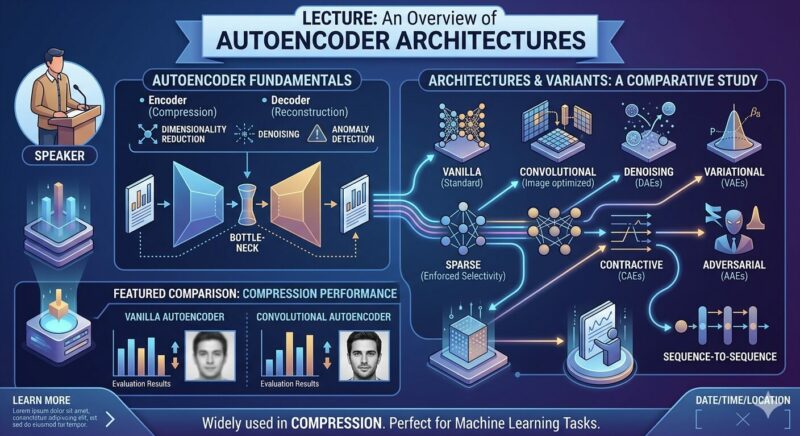
Autoencoders have become a fundamental tool in unsupervised learning, addressing various challenges such as dimensionality reduction, denoising, anomaly detection, and generative modeling. At their core, autoencoders consist of an encoder that compresses input data into a lower-dimensional representation and a decoder that reconstructs the original input. While standard autoencoders are effective for feature extraction, they suffer from generalization issues, leading to the development of specialized variants.
This lecture provides an overview of several autoencoder types, including Denoising Autoencoders (DAEs) that enhance robustness against noise, Variational Autoencoders (VAEs) that introduce probabilistic modeling, Sparse Autoencoders that enforce feature selectivity, Contractive Autoencoders (CAEs) that ensure stability against small input changes, Adversarial Autoencoders (AAEs) that integrate generative adversarial training, Convolutional Autoencoders (CAEs) optimized for image processing, and Sequence-to-Sequence Autoencoders designed for sequential data. Each variant offers unique advantages for specific machine learning tasks. Additionally, compression was implemented using vanilla and convolutional autoencoders, and the results were evaluated. These autoencoder types were chosen because they are widely used in compression.
Speaker
Gökhan Karabıyık has been working as an electrical and electronics engineer at a private defense industry company in Türkiye for 8 years. He is also a doctoral student in the Management Information Systems department at Aksaray University. He completed his doctoral internship at the GAMF Faculty of John von Neumann University in 2025.
All interested are welcome! Participation in the lecture is free of charge.